
Why Your Mind Won’t Go Quiet: A Real Look at Overthinking
What Is Overthinking? (Quick Answer)
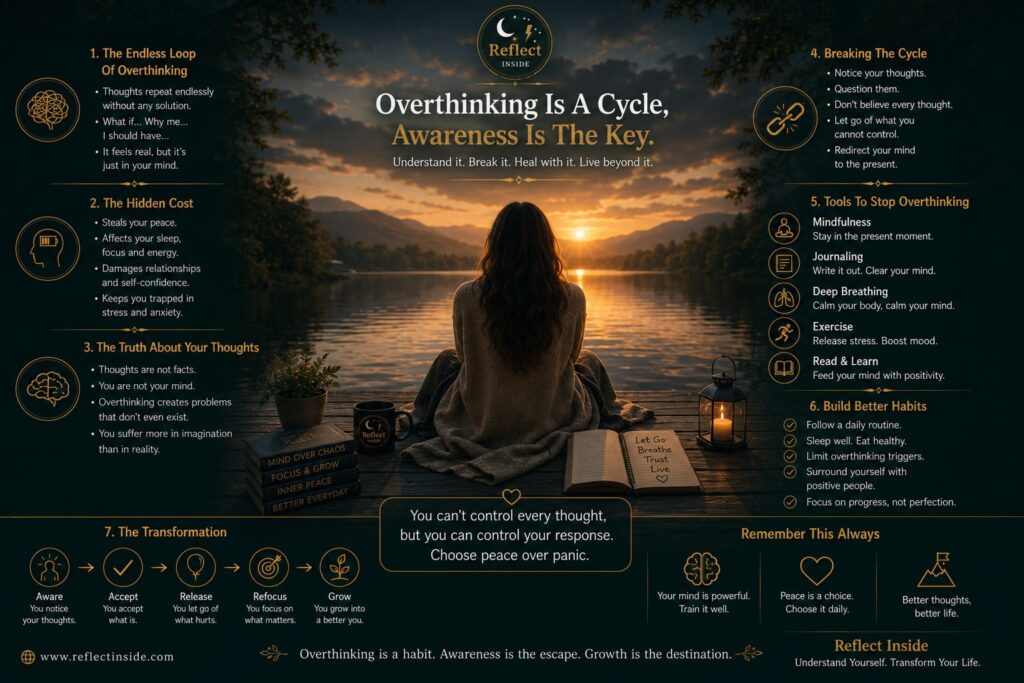
Overthinking is a mental habit where a person keeps analyzing a decision, event, or worry without ever reaching a resolution. Unlike healthy reflection, it keeps the mind busy while the real problem stays exactly where it was, often driven by fear, uncertainty, or the brain’s built-in threat-detection system.
Reflection: Before you read further, notice: is there a thought you’ve been circling today without actually resolving it?
A Familiar Scene
It’s close to midnight.
The lights are off. The house is silent. Your body is exhausted from the day.
But your mind hasn’t gotten the memo.
A conversation from three days ago surfaces out of nowhere.
“I shouldn’t have said that.”
Then your thoughts jump forward instead of back.
“What if tomorrow goes wrong?”
And right behind it, another one slips in.
“What must people think of me right now?”
You shift position in bed. The thoughts don’t shift with you.
One barely finishes before the next one starts. Somehow, an hour has quietly disappeared.

When the Noise Gets Loudest
Talking to people about this over time, one thing comes up again and again.
This exact hour, this exact silence, is when the mind seems to get loudest.
That’s the experience we call overthinking.
Quote: The brain stays busy. The problem stays exactly where it was.
It’s worth being precise about what that phrase actually means. Overthinking isn’t simply “thinking a lot.”
It’s a loop, a mental groove the mind keeps sliding back into without ever reaching a conclusion.
This article looks at what overthinking really is, why the brain defaults to it, and what genuinely helps loosen its grip, drawing on both psychological research and patterns that show up again and again in everyday life.
What Overthinking Actually Is
Thinking itself is not the enemy here.
It’s how we plan, learn from mistakes, and make sound decisions. A person who never thought things through would struggle with even ordinary choices.
But not every thought pulls its weight.
In psychological terms, overthinking is a mental state where a person keeps circling back to an event, a decision, a relationship, a mistake, or a future worry. The repeated thinking never produces a workable answer.
From the outside, it can look like problem-solving. From the inside, it’s closer to walking in a circle.
A Simple Way to Picture It
Picture sitting on a playground swing.
The swing is moving the entire time, but you’re not going anywhere.
That’s a fair picture of what overthinking feels like from the inside: constant mental motion, with life staying exactly where it was.
Thinking Longer Isn’t the Same as Overthinking
This distinction matters more than people usually realize.
Many assume that spending a long time on a decision automatically means they’re overthinking it. That’s not necessarily true.
Say you’re weighing a new job offer. You’re gathering information, comparing options, and eventually you decide. That’s healthy deliberation.
But if weeks go by and you’re still stuck on the same decision, dreading every possible outcome, unable to actually move, that’s overthinking.
Key Takeaway: The difference isn’t how long you think. It’s what the thinking produces. Healthy thinking eventually leads somewhere. Overthinking keeps you exactly where you started.

Why the Brain Does This
This might be the most important question in the entire piece.
Most people quietly blame themselves for it.
“I take everything personally.”
“I just don’t have enough confidence.”
But the truth is less personal than it feels. This isn’t only about who you are. It’s built into how the human brain is wired.
The Alarms That Replaced the Tiger
Over hundreds of thousands of years of evolution, the brain became finely tuned for one job above all others: staying alive.
Missing a real threat in the ancestral environment could be fatal. So the brain developed a hair-trigger system for spotting danger fast.
We’re no longer dodging predators, but that detection system never got the update. It still runs the same way.
The tiger is gone. In its place, a different set of alarms fires:
- What if I fail?
- What if they reject me?
- What if I’m wrong about this?
- What if everything falls apart?
The brain treats these questions with the same urgency it once reserved for a genuine physical threat.
The Negativity Bias
There’s a well-documented concept in psychology called the negativity bias.
Psychologist Roy F. Baumeister, whose widely cited research paper is literally titled “Bad Is Stronger Than Good,” found that the brain consistently weighs negative information more heavily than positive information, even when there’s more of the positive kind.
Say you receive ten compliments in a day and one piece of criticism. Which one keeps you company at bedtime?
For most people, it’s the criticism.
Reflection: Think of the last time this happened to you. How many compliments did it take to outweigh one piece of criticism?
This isn’t a personal flaw. It’s simply how the brain is built.
The trouble starts when this same tendency begins treating every minor inconvenience as a potential threat. That’s usually where overthinking takes over.

What Usually Feeds Overthinking
Everyone’s story is a little different, but a handful of patterns show up consistently in psychological observation.
1. Wanting Every Decision to Be Flawless
Some people are so afraid of getting it wrong that they weigh dozens of possibilities before making any decision at all.
They’re chasing the best possible choice. In that chase, they often end up making no choice whatsoever.
2. Old Wounds That Haven’t Fully Healed
If someone has been through betrayal, failure, harsh criticism, or emotional pain before, their brain often starts over-analyzing everything, trying to avoid a repeat of that experience.
It’s a protective strategy, even when it doesn’t feel like one.
3. Not Trusting Your Own Judgment
When someone doesn’t fully trust their own opinions, every decision starts to feel questionable, even after it’s made.
“Maybe the other option would have worked out better.”
That lingering doubt is exactly what keeps the overthinking cycle running.
4. Struggling to Sit With Uncertainty
Life doesn’t come with answers to every question in advance.
Some people make peace with that. Others feel compelled to know every possible outcome before it happens.
When that’s not possible, which it usually isn’t, the brain keeps manufacturing new worries to fill the gap.
Tip: Notice which of these four patterns feels most familiar to you. Naming it is often the first step toward loosening its hold.

A One-Minute Gut Check
Before reading any further, take a minute and ask yourself three questions:
- Am I actually solving this, or just replaying it?
- Is there real evidence behind this worry, or is it just a feeling?
- If a close friend brought me this exact problem, would I give them the same advice I’m giving myself?
These three questions alone are often enough to create a little distance between you and the thought loop you’re stuck in.
Quote: That small distance is the first real step out of it.
Which brings us to something worth understanding next: overthinking often has warning signs that hide in plain sight, because most people mistake them for normal, everyday habits.
The Warning Signs People Usually Overlook
Overthinking rarely announces itself loudly.
More often, it settles quietly into daily life. A person assumes they’re simply “someone who thinks a lot,” without realizing they’re actually caught in a recurring cycle of mental strain.
That’s exactly why recognizing the early signs matters.
1. Replaying the Same Moment Over and Over
Have you ever noticed how a single conversation, a mistake, or one offhand comment from someone can loop in your head for days?
You keep thinking: I should have answered differently. I wish I’d stayed quiet. Why did they say that?
The moment itself is long over, but the brain keeps replaying it as if it just happened.
Psychologist Susan Nolen-Hoeksema, whose research helped define this pattern, called it rumination: repeatedly revisiting a past event without extracting any new insight or resolution from it.
2. Thoughts Speeding Up at Bedtime
You’re occupied all day, but the moment things go quiet at night, your mind suddenly picks up speed.
Worries about tomorrow. Old mistakes. Unfinished tasks. Things people said.
It’s as if the brain waited all day for exactly this moment to start working.
3. Even Small Decisions Start to Feel Hard
Sometimes overthinking quietly takes away your ability to decide anything at all.
Even simple questions start to feel heavy. Which route should I take? Should I send this message or not?
The brain keeps running every possible outcome until the decision itself becomes the hardest part.
4. Jumping Straight to the Worst-Case Scenario
A loved one doesn’t pick up the phone, and your mind jumps straight to an accident.
Your manager asks for a quick meeting, and you’re already imagining losing your job.
This isn’t just caution. It’s a habit of viewing every situation through the lens of potential danger.
5. An Outsized Fear of What Others Think
Everyone wants to be seen in a good light.
But in overthinking, that ordinary wish grows out of proportion.
People start replaying how they came across, guessing at what others must be thinking of them.
The end result is a life quietly shaped around other people’s assumed opinions rather than one’s own.
6. Feeling Drained Without Having Done Much
Overthinking doesn’t just wear out the mind. It shows up in the body too.
Plenty of people say something like, “I didn’t really do anything today, but I’m still completely exhausted.”
Research on mental effort suggests that sustained cognitive activity draws on the same energy reserves as physical activity, which is why mental fatigue can feel just as heavy.
7. Constantly Needing Reassurance
People caught in overthinking often ask the people around them the same question in different words.
“Are you upset with me?” “Did I do that right?”
The reassurance brings relief, but only briefly. The same doubt tends to creep back soon after.
Key Takeaway: None of these signs need to be present all at once. Even one or two showing up regularly is worth paying attention to.

A Story That Feels Familiar
Situations like this show up in a lot of people’s lives.
Meera was a diligent student.
Right after an exam, she turned to a friend and asked how it had gone.
Her friend just smiled and said, “We’ll see.”
An entirely ordinary response.
But Meera’s mind immediately went to work building a story around it.
Maybe my paper didn’t go well. Maybe everyone did better than me. What if I actually fail this?
For the next three days, she couldn’t stop turning those thoughts over.
When results came out, she’d scored among the top in her class.
The exam was never really the problem.
Reflection: Has a small, neutral comment ever sent your own mind spinning into a full story like Meera’s? What happened when reality finally caught up?
The problem was the story her mind had already written before reality had a chance to weigh in.
This is what overthinking does more often than not: it hands our fears more power than the facts ever warranted.
It Doesn’t Stay in Your Head, It Spreads
At first, overthinking looks like nothing more than a thinking habit.
Over time, its effects start showing up across different parts of life.
In Relationships
When someone starts reading negative intent into everything, or treating silence as a sign of anger, misunderstandings multiply fast.
Often the real issue isn’t the other person at all. It’s the assumptions running in our own head.
In Work and Studies
Overthinking keeps a lot of people from ever starting.
They wait for the perfect moment, the perfect plan, or a level of confidence that never quite arrives.
Meanwhile, real opportunities quietly slip past.
In Physical Health
Overthinking isn’t a medical illness on its own. But sustained mental strain can aggravate a number of physical issues, including:
- Disrupted sleep
- Physical fatigue
- Headaches
- Muscle tension
- A general sense of unease
If these symptoms keep recurring, or start interfering with daily functioning, it’s worth speaking with a doctor or a licensed mental health professional.

A Two-Minute Writing Exercise
Grab a sheet of paper right now and take two minutes to write down:
What’s one thought that’s kept coming back to me over the past week?
Underneath it, write a second question: Is this actually true, or just a fear?
Then a third: Even if this fear turned out to be true, would I really be completely powerless to deal with it?
Tip: Keep this page. Come back to it in a week and see how many of those fears actually happened.
Overthinking’s real power lies in convincing you that thinking just a little more will finally hand you a complete answer.
Reality tends to work the other way. Most of the time, more thinking doesn’t clarify anything. It just tangles the mind further.
So the real question becomes: what actually helps break that cycle?

Practical Ways to Loosen Overthinking’s Grip
By now we’ve covered what overthinking is, why the brain defaults to it, and how it ripples outward into daily life.
The obvious next question is how to actually step out of it.
It helps to know upfront that overthinking isn’t a switch you flip off in one go. It’s a mental habit, and like any habit, it can be reshaped gradually.
The encouraging part is that the human brain is genuinely capable of learning and adapting. Researchers describe this capacity as neuroplasticity, the brain’s ability to reorganize itself in response to new experiences and repeated practice.
1. Stop Treating Every Thought as Fact
This is the single most foundational shift in getting out from under overthinking.
Most people take every thought that crosses their mind at face value. For example:
“I’m definitely going to fail.” “Everyone thinks badly of me.”
Pause for a moment before accepting any of that. Does a thought crossing your mind make it true? Not remotely.
The brain manufactures thousands of thoughts every single day. Plenty of them are exaggerated, unrealistic, or driven purely by fear.
So the next time a distressing thought shows up, try asking yourself these three questions:
- Is this thought grounded in reality, or just fear?
- Would I take this as seriously if it were happening to someone else?
- How much will this actually matter six months from now?
A Quick Example
Say you text a friend and hours pass without a reply.
Overthinking jumps straight to a conclusion: they must be upset with me.
But there are plenty of other explanations. Maybe they’re busy. Maybe their phone is on silent.
Overthinking just happens to pick the worst one, every time.
Quote: A single situation can be read in several different ways. Only one of them is usually true.
2. Get the Thought Out of Your Head and Onto Paper
The brain wasn’t built to store thoughts indefinitely. It’s built to act on them.
When the same thought keeps circling in your head, it starts to feel far bigger than it actually is.
Take a plain sheet of paper and write two headings: What am I actually worried about? and What’s within my control here?
For example: Worry: what if the interview goes badly? Within my control: preparing well, arriving on time, staying calm.
Tip: After just a few minutes of writing, most people realize how much of their worry was tied to things they had no power to change in the first place.
3. Give Every Decision a Deadline
One of the biggest drivers of overthinking is postponing decisions instead of actually making them.
There’s a quiet assumption that thinking a little longer will eventually produce total certainty. It rarely does.
Set yourself a simple rule:
- Small decisions: 10 minutes.
- Medium decisions: one day.
- Big decisions: a few days, but not an open-ended timeline.
When the time is up, decide based on the information you already have.
Not Deciding Is Still a Decision
Some people assume that avoiding a decision protects them from making a mistake.
In reality, not deciding is a decision in itself, and often it’s the most costly one.
Reflection: Is there a decision you’ve been postponing right now? What would happen if you gave it a deadline this week?

4. Bring Your Attention Back to the Present
Overthinking almost always lives in one of two places: the past, or the future.
Calm, meanwhile, is only ever found in the present.
This is why mental health professionals worldwide, including mindfulness researcher Jon Kabat-Zinn, teach exercises that pull people back into the present moment.
Here’s a simple one to try. Look around you and:
- Notice five things you can see.
- Notice four things you can touch.
- Notice three things you can hear.
- Notice two things you can smell.
- Notice one thing you can taste.
A Breathing Exercise
If your thoughts are moving unusually fast, spend just one minute focusing entirely on your breath.
Breathe in slowly. Hold for a moment. Then release slowly.
This won’t solve the underlying problem, but it can calm the mind enough to think more clearly afterward.
5. Choose Action Over Analysis
More often than not, the real antidote to overthinking isn’t more thinking. It’s action.
Say you’ve spent days circling around writing an email or having a difficult conversation.
The longer you wait, the more worries your brain will invent to fill the space.
Instead, tell yourself something simple: I’ll work on this for just five minutes. Nothing more.
Key Takeaway: Most people discover that the real obstacle was never the task itself. It was starting.
Small Steps, Real Results
A lot of people wait for one dramatic transformation before they’ll change anything.
But specialists who study habit formation consistently point to something different: small, steady actions tend to outperform big, occasional bursts of effort.
A little daily improvement adds up quietly, and after a few months, the difference becomes genuinely visible.
Today’s Exercise
Pick one task you’ve been putting off for days. Now take only its very first step.
If it’s a book you meant to read, read two pages. If it’s a call you need to make, just dial the number.
6. Let Go of the Need to Control Everything
A major driver of overthinking is the desire to keep every part of life within our control.
We want every decision to turn out right, everyone to like us, and no future problems, ever.
But life simply doesn’t work that way.
You can’t control the weather. You can’t change what other people think. You can’t predict every event that’s coming.
There’s exactly one thing you genuinely control: your own response.
Reflection: Ask yourself daily: is this actually within my control? If yes, take action. If no, let it go a little.
7. Take Care of Your Body, Because Mind and Body Are Connected
A lot of people chase mental peace while completely neglecting their physical health.
The truth is, your brain isn’t separate from your body.
If you’ve been running on poor sleep, drinking too much caffeine, or staring at screens constantly, overthinking tends to intensify.
Try building in a few of these small habits:
- Keep a fairly consistent sleep and wake schedule.
- Walk for at least 20 to 30 minutes daily.
- Drink enough water.
- Cut back on caffeine, especially later in the day.
- Stay off screens for at least half an hour before bed.
8. Talk to Yourself the Way You’d Talk to a Friend
When you make a mistake, what do you actually say to yourself?
For a lot of people, it sounds something like “I always mess up” or “I’m just not capable.”
Now imagine a close friend made that same mistake. Would you say the same thing to them? Probably not.
Psychologist Kristin Neff, whose research popularized this idea, calls it self-compassion: treating yourself with the same warmth you’d offer someone else.
Her studies found that people who respond to mistakes with self-compassion, rather than harsh self-criticism, tend to cope better with stress and with overthinking itself.
Tip: Whenever a self-critical thought shows up, swap it for a kinder version. “I’m a failure” becomes “I’m still learning.”
9. Don’t Hesitate to Seek Help When You Need It
Sometimes overthinking isn’t just a habit anymore. It can be tied to a larger mental health concern, such as significant anxiety or depression.
If you notice that your peace of mind has been gone for weeks, sleep is consistently disrupted, or relationships and work are being affected, reaching out to a licensed mental health professional is a genuinely sound decision.
Quote: Asking for help isn’t weakness. It’s taking responsibility for your own well-being.

Habits That Quietly Make Overthinking Worse
Sometimes, without realizing it, we pick up habits that reinforce the very problem we’re trying to solve.
Constantly Seeking Reassurance
If you’re regularly asking people “Did I do the right thing?”, you might feel better in the moment, but your brain slowly becomes dependent on that reassurance instead of building its own confidence.
Comparing Yourself Nonstop
Watching other people’s highlight reels on social media and measuring your entire life against them can fuel overthinking fast.
Remember, most people only post their best moments, not the full picture.
Treating One Mistake as Your Whole Identity
One bad decision doesn’t make you a failure.
A mistake is an event. It’s not who you are.
Waiting for the “Perfect” Moment
Plenty of people say, “I’ll start once I feel completely ready.”
That feeling of complete readiness rarely ever arrives. Progress comes from action, not from waiting.
A Five-Minute Morning Routine
If you want your day to start on a calmer note, try these three things each morning:
- Take three deep breaths.
- Write down only the three most important tasks for today.
- Ask yourself: what’s the one thing I’ll focus on today, instead of everything at once?
A Five-Minute Evening Routine
Before bed, put your phone aside and write down three questions on paper:
- What am I proud of from today?
- What worried me today?
- Can this be resolved today, or can it wait until tomorrow?
Then say one sentence to yourself: today is done. I’ll think about the rest tomorrow.
Tip: Even a small statement like that can signal to your mind that it’s safe to rest.

Thoughts Aren’t the Same as Facts
The goal here was never to make sure a negative thought never crosses your mind again. That doesn’t happen to anyone.
The real goal is making sure that when a negative thought does show up, it doesn’t take over your entire day.
Reflection: You don’t get to choose which thoughts show up. You do get to choose how much weight you give them.
Which naturally raises another question: how exactly does overthinking relate to anxiety?

How Overthinking and Anxiety Are Connected
A common question people ask is whether overthinking and anxiety are the same thing. The answer is no, though the two are often closely linked.
Overthinking is a thinking pattern. Anxiety is more of an emotional and physical state.
If someone keeps predicting that something bad is about to happen, that ongoing tension can eventually show up in the body too: a racing heart, disrupted sleep, restlessness.
In other words, overthinking can fuel anxiety, and anxiety can fuel overthinking.
Is Overthinking Always Harmful?
Not necessarily. Careful thought before an important decision can genuinely pay off.
For example: choosing a new job, starting a business, or weighing a major financial decision.
The trouble starts when thinking replaces action altogether.
When Should You See a Psychologist?
Not everyone who thinks a lot needs treatment.
But if overthinking is causing weeks of poor sleep, ongoing strain in relationships, or persistent anxiety, speaking with a licensed professional is a sensible step.
Key Takeaway: Getting help early can prevent bigger difficulties down the road.
A Few Common Misconceptions About Overthinking
Misconception 1: People Who Overthink Are Simply More Intelligent
Intelligence and overthinking are not the same thing.
A highly intelligent person can still think in a balanced way, while overthinking can leave anyone stuck in confusion rather than clarity.
Misconception 2: More Thinking Will Eventually Produce the Perfect Solution
Not every problem gets solved by thinking about it more. Plenty of problems are only solved through action.
Misconception 3: Overthinking Is Just Who I Am, and I Can’t Change It
That’s not accurate. The brain is capable of learning new patterns.
With consistent practice, the way you think can genuinely shift over time.
Seven Small Habits Worth Starting Today
- Do one thing each day that you’ve been avoiding for a while.
- Spend five minutes daily writing down your thoughts.
- Cut back on phone use before bed.
- Remember your wins too, not just your mistakes.
- Don’t automatically believe every negative thought.
- Compare yourself to others less often.
- Speak to yourself with patience and respect.

Summing It All Up
Overthinking isn’t just thinking a lot. It’s a mental loop where a person travels a great distance in their head without actually moving forward in life.
It’s usually tied to fear, discomfort with uncertainty, past experiences, low self-trust, and the brain’s built-in survival instincts.
Getting out of it doesn’t require a magic fix. It requires small, consistent daily habits.
Key Takeaway: When you stop treating every thought as fact, stay present, choose action over endless analysis, and treat yourself with genuine kindness, your mind gradually learns a new way of operating.
Frequently Asked Questions
Is overthinking a mental illness?
No, overthinking on its own isn’t a mental illness. It’s a thinking habit. If it persists for a long time, though, it can contribute to problems like anxiety or depression.
What’s the difference between overthinking and anxiety?
Overthinking is a pattern of thought, while anxiety is more of an emotional and physical state. The two frequently feed into each other, but they aren’t the same thing.
Can overthinking be completely eliminated?
The goal isn’t to stop thoughts from ever showing up. It’s to gain more control over how much power those thoughts hold.
What’s the fastest way to interrupt overthinking in the moment?
A short breathing exercise, the five-senses grounding technique, or taking one small action for five minutes can all help calm the mind quickly.
Does overthinking run in families?
It hasn’t been proven to be directly hereditary, but upbringing and past experiences can reinforce the habit over time.
When should someone see a psychologist for overthinking?
If it’s consistently affecting sleep, daily functioning, relationships, or work, consulting a licensed mental health professional is a reasonable next step.

A Closing Thought
If you’ve made it this far, there’s a decent chance your own mind has been running loud for a while now.
Maybe you’re caught up in a decision, a relationship, a mistake, or a fear about what’s coming.
Reflection: If that’s where you are, hold on to this one idea: your thoughts are not the whole story of who you are.
The brain’s job is to generate possibilities. Deciding which of those possibilities deserve your attention is entirely up to you.
Don’t try to change your whole life in a single day. Just take one small step today.
Write down one worry that’s been sitting heavy. Finish one task you’ve left hanging. Reach out to someone you trust.
Quote: Peace of mind rarely starts once every problem has been resolved. It usually starts the moment someone decides to stop chasing every thought and return, instead, to their actual life.
Join the Conversation
What’s one thought you keep revisiting, even when you know it isn’t fully rational? Share it in the comments below. Sometimes naming a thought out loud is the first step to loosening its grip.
Continue Reading on Reflect Inside
If this resonated with you, you may also want to explore these related reads:
- Understanding Anxiety and Where It Comes From
- The Science of Neuroplasticity: How the Brain Actually Changes
- Building Self-Compassion: A Daily Practice
Stay Connected
If you’d like more reflections like this delivered directly to you, subscribe to the Reflect Inside newsletter for new articles on mental wellness, emotional clarity, and everyday psychology.

Key Psychological Research Behind This Article
Several of the core concepts referenced in this piece draw on the work of the following researchers:
- Kristin Neff — foundational research on self-compassion.
- Susan Nolen-Hoeksema — research on rumination and repetitive negative thinking.
- Roy F. Baumeister — the widely cited paper on negativity bias, “Bad Is Stronger Than Good.”
- Jon Kabat-Zinn — mindfulness and present-moment attention practices.
- Carol Dweck — research on the brain’s capacity for change, often described through the growth mindset framework.
Pingback: Stop Seeking Everyone's Approval: The No. 1 Psychology
Pingback: Quiet Habits of Intelligent People: 7-Step REFLECT Framework
Pingback: 7 Childhood Emotional Neglect Signs That Stay for Life