
The Survivorship Bias: The 1 Subtle Trap We Fall Into Every Single Day
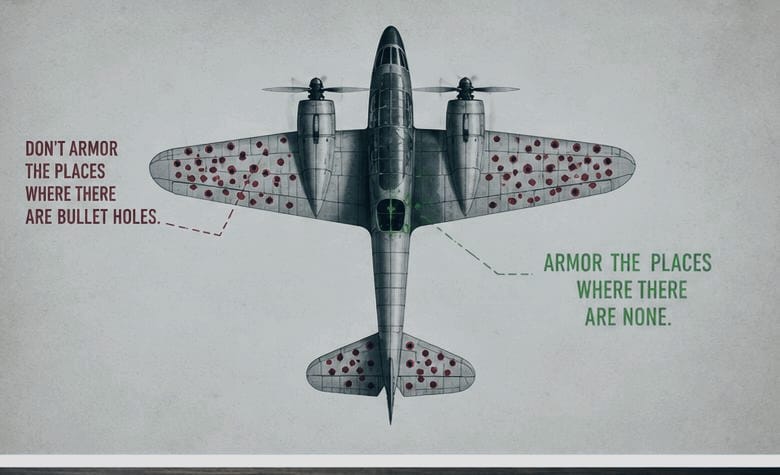
During World War II, engineers examined returning fighter planes to see where they had been hit by enemy fire. The bullet holes were concentrated on the wings and the tail. The immediate, logical conclusion was to reinforce those areas with more armor. It made perfect sense.
Then came Abraham Wald, a mathematician who challenged the consensus with a simple, jarring insight: Don’t armor the places where there are bullet holes; armor the places where there are none.
Wald understood something the rest had overlooked. The data only represented the planes that made it back. A plane could take fire to the wings or tail and still return to base. But those that took hits to the engine or the cockpit? They never returned at all. The absence of bullet holes on the engines wasn’t a sign of safety; it was the mark of a fatal hit. This is what we call Survivorship Bias: the tendency to focus on the survivors and lose sight of the failures who have vanished from the record.
The Mind That Cannot Read Silence
For millions of years, the human brain was wired for immediate survival: observe what is in front of you, draw a conclusion, and act. It was a survival mechanism that worked perfectly for ancestors dodging predators.
However, in the modern world, this shortcut often backfires. When we see ten successful people, our brains immediately race to identify their secret sauce: their wake-up times, their work ethic, or their specific habits. We turn these into a blueprint for success. But our brains never ask the critical question: What about the thousands of others who did the exact same things and still failed?
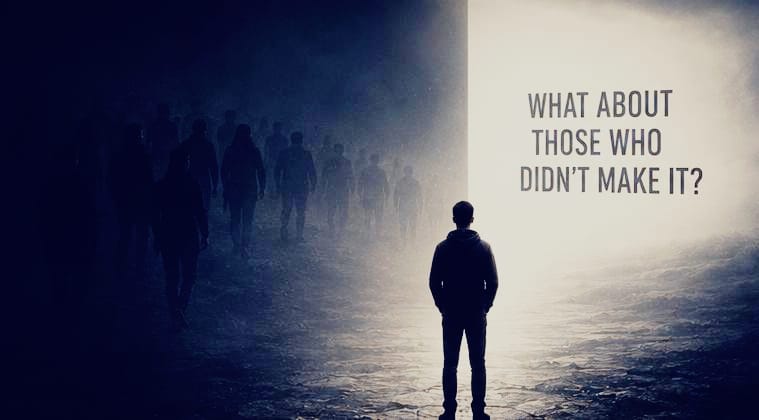
We don’t ask because those failures aren’t visible. They aren’t writing books, they aren’t giving TED talks, and they aren’t viral sensations. They are silent, hidden in the shadows. This silence creates a cognitive trap that works on us from the inside out, unnoticed.
The Books That Mislead While Telling the Truth
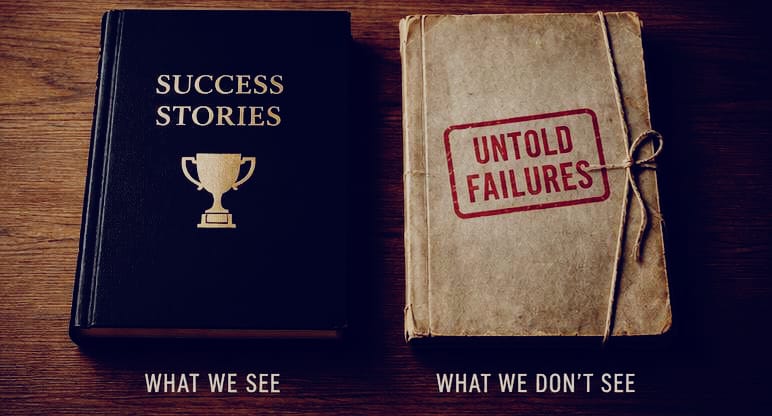
Every year, bookshelves are flooded with success stories about companies that made it. The reader devours these pages, thinking they have found the map to prosperity.
But for every company whose success story is now canon, there were hundreds of others twenty years ago that made the exact same strategic decisions and went bankrupt. The visionary leadership we praise today in that one company is often a narrative constructed after they survived, not the actual cause of their success. In fact, researchers have found that many companies celebrated in bestselling management books often struggle or fail just a few years later. The formula failed even those who wrote it. The book sold, the lesson spread, but the reality simply faded away.
A Personal Lesson from Clinical Practice
In the field of mental health, I have encountered this bias repeatedly. To be honest, I was once a victim of it, too. When a therapy proves effective, we naturally highlight the patients who completed the course and saw results. But what about the ones who dropped out after two or three sessions?
Perhaps the method didn’t work for them. Perhaps it wasn’t the right fit. But because they vanished from the data, the success rates of our treatments appeared inflated. This isn’t just my experience; the entire medical field has wrestled with this for decades. Many drugs were hailed as highly effective based only on the patients who stuck to the regimen, while the voices of those who quit were never counted. Even in a white coat, the bias persists.
The Most Authentic Lie in a Virtual World
A young creator posts a video, hits a million views in six months, and suddenly everything changes: the car, the house, the lifestyle. Watching that story, our hearts convince us that if they can do it, I can do it.
It isn’t a lie, but it is an incomplete picture. Millions of others spent three years, poured in their savings, and worked tirelessly, only to eventually walk away from the dream. Their stories aren’t viral. Failure doesn’t get a documentary. We listen to the winners because they are the only ones left standing, and then we base our life’s most important decisions on that skewed perspective. When we fail, we blame ourselves, not realizing we were trying to follow a path that was missing half its map.
The Oldest Lie in History
If asked which civilizations were the greatest, we name Egypt, Greece, China, or the Indus Valley. But hold on, these are simply the civilizations whose remnants survived. The ones whose stone monuments didn’t crumble to dust. The civilizations that were completely wiped out, leaving no trace behind, have been erased from the human narrative. We call what remains History, but in reality, we are only looking at the survivors.
We Do This to Ourselves
The most painful manifestation of this bias is how we view our own lives. We remember the decisions that turned out well. We catalog the gambles that paid off, building a self-narrative that says I am a good decision-maker.
And the failures? The ones that cost us everything? Our minds slowly blur the edges of those memories. That was just bad luck, we tell ourselves. The circumstances were different back then. We filter out our own failures to preserve our ego, leading us to walk into the future with a false sense of certainty.
Learning to Read the Silence
Perhaps we can never fully escape this bias, but we can recognize it, and that recognition is a massive leap forward.
The next time you hear a success story, pause. Ask yourself: How many others tried this exact path and didn’t reach the end? This question isn’t meant to breed pessimism; it is meant to clear the fog. Before starting a business, look for those who failed, not just those writing books. Before adopting a new habit, ask if it truly causes success, or if it is just something successful people happen to have in common.
The Survivorship Bias is woven so deeply into our cognition that we rarely feel its tug. Real truth is often found where there is no story, no applause, and no name. Learning to read the silence is perhaps the most difficult but most essential skill we can develop.
The Systematic Distortion of Our Reality
We don’t just make biased decisions as individuals. We’ve built entire systems on them. The way history is taught in schools, the way news covers economic growth, the way success stories are packaged and sold to us. All of it is carefully curated to show only what survived. What didn’t make it never gets a mention.
Look at how we talk about startups. We turn certain founders into something close to mythology.
We study their morning routines, their company cultures, their pitch decks, as if success left behind a map that anyone can follow. But nobody talks about the hundreds of founders who did the same things, believed just as hard, and still watched their companies quietly disappear. Not because they failed to follow the formula. But because the formula was never really a formula to begin with.
The same thing plays out on our phones every day. Social media doesn’t show you someone’s Wednesday at 2am when nothing is working. It shows you the promotion, the vacation, the milestone post. So when your own life feels like it’s mostly rehearsals and setbacks, you assume something is wrong with you specifically. When in reality, you’re just seeing the full version of something everyone else is only showing you in highlights.
The rehearsals aren’t the exception. They’re almost the entire story. Knowing that doesn’t make the hard parts easier. But it does make them feel a little less like evidence that you’re doing it wrong.
The Hidden Cost of Ignoring the Unseen
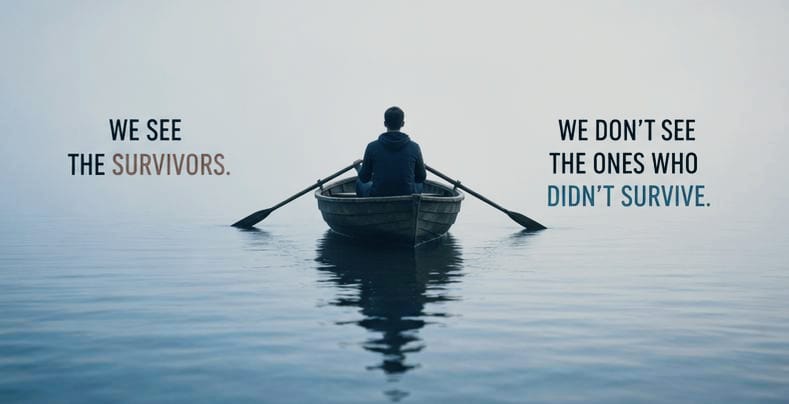
We often look at successful people and try to follow their path, rarely stopping to think about those who took the same route and never made it. Their stories may be invisible, but the lessons they carry are just as important. When we ignore failure, we risk making decisions based on only half the picture.
Real wisdom comes not only from studying success, but also from understanding why others fell short.
Join the Discussion
When you look back at your own life or career, what is one “failed” decision you made that you now realize was actually a valuable lesson the world never got to hear?