
Stop Seeking Everyone’s Approval: The No. 1 Psychology Behind Living for Yourself
Stop seeking everyone’s approval is one of the most important psychological shifts a person can make. When your happiness depends on other people’s opinions, you gradually lose touch with your own values and identity.
Sara had cancelled the appointment twice before she finally sat down across from her therapist. “I posted something last night,” she said, staring at her phone instead of making eye contact. “By this morning it only had a handful of likes, so I deleted it. Then I spent the whole day wondering what people thought of me. Did I look desperate? Did my friends think less of me?”
Nothing had actually happened to Sara. No one had criticized her. No one had said a cruel word. And yet she had spent an entire day in quiet distress over a number on a screen. If any part of that story feels uncomfortably familiar, you are far from alone, and there is a well documented psychological explanation for exactly what is happening.
Most of us spend a significant portion of our lives fighting a battle that cannot be won: the battle to keep everyone happy, to meet every expectation placed on us, and to look acceptable in the eyes of people whose opinions, if we are honest, rarely matter to our long term wellbeing. The longer that battle continues, the further we drift from our own goals, our own values, and eventually our own identity.
At Reflect Inside, we work from a simple premise: lasting peace of mind is never found in someone else’s applause. It is found in the slow, deliberate work of reconnecting with yourself. That is the journey this piece walks through.
“The day you take the remote control of your happiness back from other people is the day your freedom actually begins.”

The Approval Trap: A Battle You Were Never Meant to Win
Notice how many people reach for their phone first thing in the morning, not to check the time, but to see how many people responded to last night’s post. This is not simply a habit. Psychologists refer to it as social validation seeking, the tendency to measure our own worth through other people’s reactions.
The trouble is that this particular well never fills up. The more approval you chase, the hungrier you get. One compliment creates an appetite for ten more, while a single piece of criticism can ruin an otherwise good day. The uncomfortable truth is that you will never please every person you meet, and the sooner that reality is accepted, the lighter life becomes.
If you succeed, someone will say you have changed. If you fail, someone will say they saw it coming. If you take an unusual path, someone will call it reckless. If you follow the crowd, someone will say you have no mind of your own. Whatever direction you choose, some form of criticism is waiting for you at the end of it, which raises an obvious question: if criticism is unavoidable either way, why not choose the path that satisfies you rather than everyone watching from the sidelines?
The Reflect Inside Self Focus Framework, Letter One: R (Recognize)
Everything that follows in this piece rests on one uncomfortable but necessary question: can you actually tell the difference between a decision made from desire and one made from fear? The first step of the Reflect Inside Self Focus Framework is Recognize, learning to notice your own hunger for approval without turning that noticing into self criticism. Nothing changes until this pattern is seen clearly.

Why You Should Stop Seeking Everyone’s Approval
From early childhood, most of us are taught that a good child is one who listens, earns the teacher’s praise, never disappoints their parents, and looks respectable in front of relatives. None of that advice is inherently wrong. But over years, it quietly builds a mental architecture in which happiness is tied to external opinion rather than internal conviction.
Psychologists describe this using the concept of locus of control. People with what is called an internal locus of control believe they hold the reins of their own outcomes. People with an external locus of control believe those reins are held by fate, circumstance, or other people’s judgment. When someone spends years operating from an external locus of control, other people’s opinions become a kind of remote control over their mood, their choices, and eventually their sense of self.
Decades of research from psychologists Edward Deci and Richard Ryan, later expanded through studies published by the American Psychological Association, point to the same conclusion through what is known as self determination theory. Human wellbeing rests on three core needs: autonomy, competence, and a sense of genuine connection to others. When a person’s decisions are driven almost entirely by a need for approval, the need for autonomy gets quietly sacrificed, and that sacrifice is where much of our modern anxiety actually comes from.
Zara grew up alongside her cousin Mahnoor, in the same school, the same neighborhood, practically the same childhood. But somewhere in their twenties, Mahnoor’s life started to look, at least online, effortlessly polished. A scholarship abroad. A promotion. Photographs that always seemed to catch the perfect light. Zara had never really compared herself to anyone before, yet she found herself lying awake scrolling through Mahnoor’s updates, quietly asking why her own life felt like it was falling behind.
When Zara eventually came in for counselling, the underlying issue was not depression in any clinical sense. It was that she had started measuring her own life against someone else’s highlight reel. Her counsellor asked her one simple question: if Mahnoor had never joined social media at all, would your own life still feel this incomplete? Zara sat with that question for a long moment before admitting the honest answer was no.
“Comparison is the quiet thief of contentment, and most of the time we never even notice it happening.”

Reflect Inside Reflection
Ask yourself today whether you are measuring your own life against a picture that was never the full truth to begin with.
Pause
Take a slow breath and think honestly about whether the person you keep comparing yourself to is really showing you their entire life, or only their best five seconds of it.
Practice
Step back, even briefly, from one account or one person who consistently triggers this kind of unhealthy comparison in you.
Key Insight
Your pace is your own. Someone else’s timeline was never meant to be the measuring stick for yours.
When Other People’s Opinions Become the Remote Control for Your Happiness
People who chase approval constantly are, without realizing it, handing the controls of their own happiness to somebody else. If your mood depends entirely on whether someone praised you or criticized you today, then your emotional wellbeing has effectively become the property of anyone with an opinion about you.
It is an exhausting way to live. Praise arrives and you feel lifted. Criticism arrives and you feel deflated. Your internal state stays permanently at the mercy of external circumstance. What makes this even more troubling is that the very people whose opinions you fear so much are usually wrestling with their own insecurities, their own unresolved history, and their own private struggles. Their opinion of you often says far more about them than it ever says about your actual worth.
The people whose disapproval you dread will not live your life for you. They will not carry the consequences of your choices, and they will not feel the particular joy of your achievements the way you will. So why hand them so much control over what you build?
“Someone who spends their life trying to keep everyone happy eventually loses touch with themselves.”
Genuine success rarely comes from collecting permission slips from other people. It tends to arrive quietly, while someone keeps improving in private and stays loyal to their own vision, regardless of who is watching.

Discipline Beats Motivation: The Quiet Work Nobody Applauds
One of the more persistent myths about achievement is that it requires a constant state of excitement, a permanent supply of motivation. The reality is closer to the opposite. Motivation is a mood, and moods pass, the same way weather changes. What actually produces results is discipline, the habit you keep even on the day you genuinely do not feel like it.
The Reflect Inside Self Focus Framework, Letter Two: E (Evaluate)
Once the pattern has been recognized, the next step is Evaluate. Before any significant decision, pause and ask a direct question: is this coming from what I actually want, or from what I am afraid other people will think? That single habit of pausing and evaluating slowly reveals which choices in your life genuinely belong to you.
Plenty of people say they want success while their daily behavior tells an entirely different story. They spend hours scrolling through other people’s lives, complain about their circumstances, yet take no concrete steps to build their own skills. Achievement is never handed over as a gift. It is earned by the person who gets up early, who stays focused while everyone around them is distracted, and who takes full ownership of their choices instead of manufacturing excuses.
“Discipline is the quiet language in which a person keeps a promise to themselves.”

Scattered Attention and the Weight of Family Expectations
Hamza was nineteen the first time he walked into a counsellor’s office, hands trembling slightly, clearly running on very little sleep. His father wanted him in medical school. His entire extended family agreed that becoming a doctor was the only respectable path. But Hamza’s heart was in design and illustration, and every time he brought it up, the same response came back: what will people say about a doctor’s son studying art?
So Hamza started preparing for his medical entrance exam, not out of desire but out of pressure. The result was that he could not give his full attention to the exam, and he could not give his full attention to his art either. His focus stayed split between two competing forces, his father’s expectations on one side and his own heart on the other, and the result showed up as anxiety, sleeplessness, and a quiet disappointment in himself.
During counselling, Hamza was introduced to an important distinction. Constructive advice and fear based pressure are not the same thing. Constructive advice genuinely wants your wellbeing and respects the decision you eventually make. Fear based pressure is preoccupied only with what people will say, often at the direct cost of your own happiness. Over time, Hamza had an honest conversation with his father, showed him a small portfolio of his work, and the two found a middle path, a design program with a strong academic foundation. It was not an easy decision for the family, but it was finally Hamza’s own decision.
Research out of Stanford on attention and social comparison consistently shows that constant context switching, dividing focus between competing obligations and constant social comparison, measurably reduces both performance and wellbeing. Whatever you consistently give your attention to tends to grow, which is precisely why scattered attention rarely produces meaningful progress.
“Attention is the one resource every person has in equal supply. The only real difference is where they choose to spend it.”

The Reflect Inside Self Focus Framework, Letter Three: F (Free Yourself)
Once you have evaluated where a decision is really coming from, the third step is Free Yourself, deliberately choosing to release the grip that fear has held over your choices. This does not happen overnight. It is a practice built through small decisions made from genuine desire, even when those decisions are not popular with everyone around you.
Failure Is a Teacher, Not an Enemy
Many people spend their entire lives avoiding failure, afraid of looking foolish, afraid of falling short. But failure is not the enemy it is often made out to be. It is a teacher, and arguably one of the most reliable ones available.
Cognitive behavioral therapy is built on a foundational idea worth remembering here: distress rarely comes from the event itself, but from the story we tell ourselves about that event. Failure does not automatically produce suffering. The self critical narrative that follows it, the “I am simply not good enough” story, is what does the damage. When someone learns to replace that inner narrative with something closer to “I just learned something I needed to know,” their entire emotional response shifts. This same technique appears consistently in research coming out of Harvard affiliated clinical psychology programs, and it forms the backbone of how modern therapists help patients rebuild resilience after setbacks.
“Failure is simply a mirror that shows you what still needs to be learned, not proof of what you are incapable of.”
The difference between people who eventually succeed and those who do not was never really about talent or luck. It comes down to whether someone can accept a setback, extract the lesson from it, and keep moving. Think about how many times a toddler falls while learning to walk. Does the child quit after the second fall? Never, because the child has not yet learned to interpret falling as failure, and has no concept of caring what an audience might think.

How Stop Seeking Everyone’s Approval Builds Real Confidence
Once a person stops chasing everyone’s approval, a noticeable shift toward mental calm tends to follow. This is not a coincidence, it is a well established psychological pattern. People whose sense of self rests on internal foundations, their own values, their own standards, their own effort, consistently report greater peace of mind than people whose identity depends on external praise.
Confidence is never built overnight. It comes from a long accumulation of small decisions: holding to your principles, voicing an opinion even when it is unpopular, and owning your mistakes without collapsing into total self blame. These small moments, repeated often enough, eventually build an internal structure strong enough to withstand outside pressure.
The Reflect Inside Self Focus Framework, Letter Four: L (Live Intentionally)
This is the final and most durable step in the framework. Live Intentionally means making each choice, each day, in the light of your own values rather than on autopilot, shaped by someone else’s expectations. Once Recognize, Evaluate, and Free Yourself have become habits, Live Intentionally becomes simply how you move through an ordinary day.

Putting the Reflect Inside Self Focus Framework Into Practice
Understanding a concept and actually living it are two different things. Here is the complete framework in summary form, along with a handful of practical habits worth building alongside it.
R, Recognize: Notice your own hunger for approval without turning that noticing into self blame.
E, Evaluate: Pause before each significant decision and ask honestly whether it is coming from desire or from fear.
F, Free Yourself: Begin making small decisions from genuine desire, even the ones that will not be popular with everyone.
L, Live Intentionally: Make each day’s choices deliberately, in line with your own values.
Alongside the framework itself, a few practical habits reinforce the shift:
Get Specific About What You Actually Want
Vague intentions leave far too much room for other people’s opinions and passing emotions to hijack your decisions. Write your goals down clearly and revisit them regularly.
Build a Routine You Can Actually Keep
The simplest form of discipline is a routine that moves you toward your goal daily, without depending on how motivated you happen to feel that morning.
Put Real Limits on Social Media
If most of your time is going toward watching other people’s lives rather than building your own, it is worth honestly reviewing your screen time.
Create Distance From People Who Add No Real Value
Not every relationship deserves to be preserved. Anyone who consistently belittles you or mocks your ambitions deserves a healthy amount of distance, not resentment, just distance.
Redefine What Success Actually Looks Like For You
Stop measuring success in likes, comments, or compliments. Measure it instead by how much you have genuinely grown, and that shift alone changes almost everything.
“Autonomy is never a single decision made once. It is a daily practice.”
Stop Seeking Everyone’s Approval and Start Living for Yourself
Plenty of people are afraid of standing alone. They fear rejection, fear losing friendships, fear the silence that sometimes follows an unpopular choice. But standing alone is, on occasion, exactly the right decision. The moment you stop chasing approval, you start living with actual freedom. You stop shrinking yourself to fit other people’s comfort. You stop making decisions out of fear.
Sara, Zara, and Hamza had entirely different stories, yet each arrived at the same conclusion: the day they started making their own decisions about their own happiness was the day their anxiety began to loosen its grip. Sara changed her relationship with social media, measuring it by purpose rather than numbers. Zara learned to accept her own pace. Hamza built his identity around his own craft without severing ties with his family.

Where Will You Be a Year From Now
A year from today, you will look back and see either genuine growth or time that quietly slipped away. The difference between the two comes down to one thing: how much honest attention you give, each single day, to deciding whose voice actually deserves your trust, other people’s or your own.
Their stories are proof that this particular journey is not easy, but it is entirely possible. It rarely happens in a single dramatic moment. It happens through small decisions, choosing not to delete a post, refusing one unnecessary comparison, questioning a family expectation out loud. Slowly, those small decisions add up to a life that genuinely belongs to you.
Your dreams, your goals, and your ambitions belong to you alone. No one else will ever feel them exactly the way you do, and life is too short to spend it fulfilling somebody else’s expectations. Focus on yourself, build your own strength, work quietly, and let your results speak on your behalf. Because the day you truly believe in yourself and act on that belief, you will genuinely surprise everyone around you, not for their sake, but because of a promise you finally kept to yourself.
Reflect Inside Reflection
Ask yourself just one question today: am I living according to my own decisions, or according to everyone else’s expectations?
Pause
Take a slow breath. Think of one decision in your life that stalled simply because of what people might say.
Practice
Do one thing today purely for your own values, your own dreams, or your own peace, not to earn anyone’s approval.
Key Insight
Life truly begins to change the day you let your own principles guide you instead of other people’s opinions.
Final Thoughts: Stop Seeking Everyone’s Approval
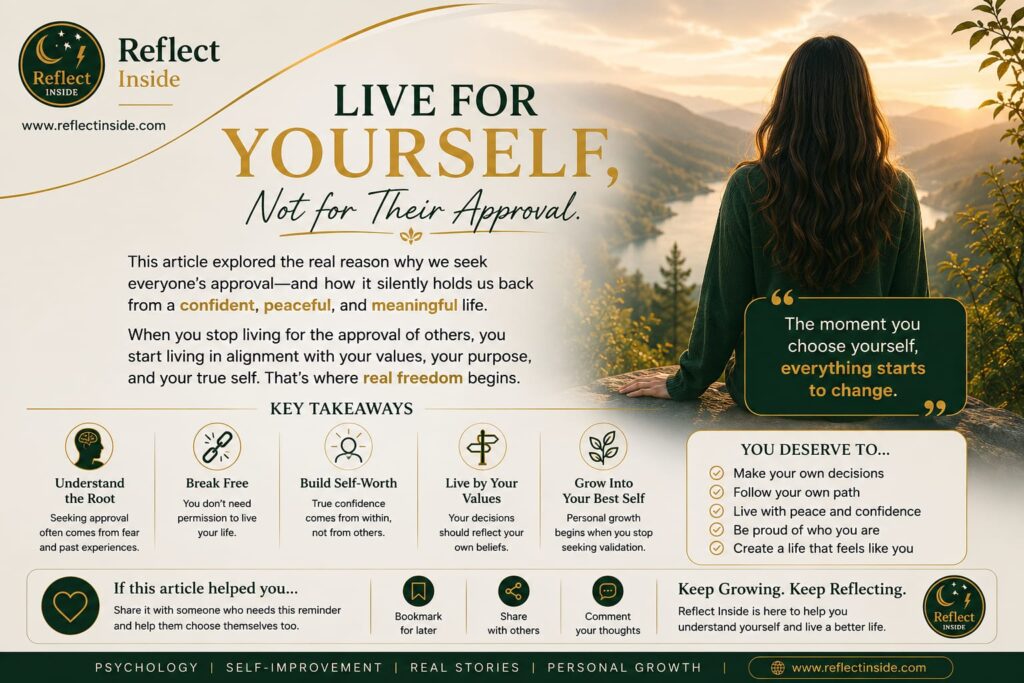
At some point, every person has to make a choice: continue living according to other people’s expectations or start living according to their own values. The truth is that you will never be able to satisfy everyone, and the more you try, the further you drift from the person you were meant to become. Learning to stop seeking everyone’s approval is not about rejecting advice or ignoring the people who care about you. It is about building the courage to trust your own judgment, make decisions with confidence, and create a life that reflects your values rather than someone else’s expectations. Your peace, your purpose, and your happiness begin the moment you stop asking for permission to be yourself.

Frequently Asked Questions
Why do people fear other people’s opinions so intensely?
This fear is usually rooted in early conditioning, where a person is taught that their worth is tied to approval from parents, teachers, and later, peers. Psychologists refer to the resulting pattern as an external locus of control, and it tends to intensify without conscious effort to change it.
Should other people’s opinions be ignored completely?
Not necessarily. Constructive feedback from people who genuinely care about your wellbeing is worth hearing. The real problem begins when decisions are made purely out of fear of judgment rather than genuine reflection and personal values.
What exactly is the Reflect Inside Self Focus Framework?
It is a four step approach: Recognize the pattern of seeking approval, Evaluate whether a decision comes from desire or fear, Free Yourself through small independent choices, and Live Intentionally by aligning daily decisions with your own values.
How can constant social media comparison be reduced?
Start by remembering that what people post online is rarely their complete reality. Limiting screen time and consciously comparing your progress to your own past, rather than to someone else’s timeline, meaningfully reduces this habit over time.
How does someone become less afraid of failure?
Viewing failure as a teacher rather than an enemy is one of the most effective shifts available. Asking what can be learned from each setback, rather than what it says about your worth, builds genuine resilience over time.
Can family pressure and personal happiness ever be balanced?
Yes, though it usually requires open, honest conversation rather than silent resentment or blind compliance. Respecting family input while still making the final decision according to your own values, as Hamza eventually did, tends to be the healthiest middle ground.
Does this mean ambition and caring what others think are always in conflict?
Not at all. Ambition can absolutely include feedback from mentors, family, and trusted friends. The distinction is between decisions shaped by genuine care and decisions shaped purely by fear of judgment, and learning to tell the two apart is really the entire point of this framework.

Resources
American Psychological Association (APA): Self-Esteem
Psychology Today: People Pleasing and Self-Worth
Greater Good Science Center (UC Berkeley): Self-Compassion and Well-Being
Verywell Mind: Building Self-Confidence
MindTools: Developing Lasting Self-Confidence
Pingback: Quiet Habits of Intelligent People: 7-Step REFLECT Framework
Pingback: 7 Childhood Emotional Neglect Signs That Stay for Life
Pingback: Self-Discipline Isn’t Willpower: 1 Psychological Guide