
The Pressure to Provide: What We Never Ask a Man
What are you worth the day you stop bringing home a paycheck?
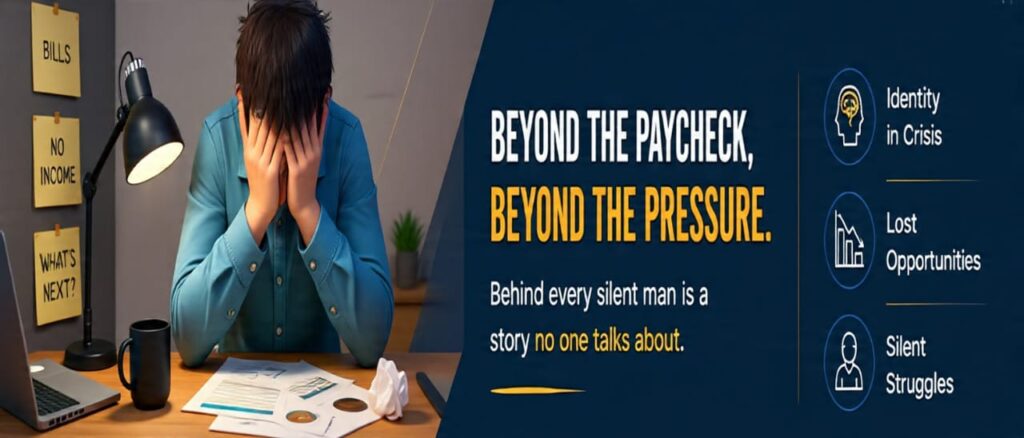
Try saying this out loud as a man: work just isn’t for me right now, whether it’s a job or a business, I don’t have the drive, I don’t want to do anything for a while, I just want some peace. Watch how fast that sentence gets rejected. In most homes, the pressure to provide never leaves room for a pause. A man who stops working isn’t seen as resting, he’s seen as failing.
The obligation to earn gets tied around your neck the moment you’re born, and it doesn’t loosen even after you’re gone. Die with property behind you, and relatives will fight over it while cursing your name in private. Die with nothing, and it’s somehow worse, because now people whisper about what kind of man leaves nothing at all. Either way, the same rope simply passes to whoever inherits it next.
We’ve built an entire vocabulary around a man’s duty to earn. Nobody ever places a matrimonial ad looking for an unemployed groom. Whatever other flaws or conditions get listed, having an income is such a baseline requirement that it doesn’t even need spelling out, it’s simply assumed that any functioning man must be bringing in money. The pressure to provide isn’t a preference in our culture, it’s treated as the entire definition of manhood.
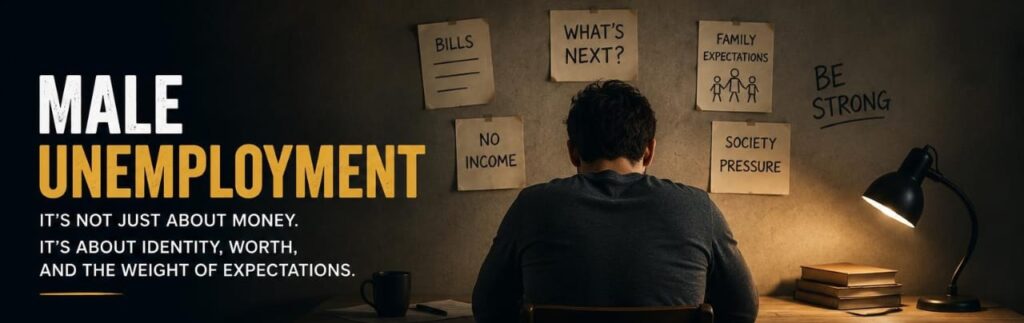
Employment has become such a rigid expectation for men that we’ve started treating it as biology rather than conditioning. Provider, breadwinner, the one who puts food on the table, gainfully employed, these words define a man before his personality ever gets a chance to. The moment that role goes quiet, his entire identity is stamped with the same verdict, useless. Morning to night, whether it’s an office, a shop, a cart on the street, or a factory floor, the goal stays identical: earn. And slowly this single goal starts eating into everything else, sleep, health, patience, love, until there’s nothing left that isn’t shaped by it.
This is even visible when a man falls sick. Whoever comes to check on him will eventually ask the same question dressed up as concern: when are you getting back to the office? Translated, it means, how much longer do you plan on lying in that bed doing nothing? When will you start earning again? When will you feed us again?

Look through every film, every drama, every novel you’ve ever consumed, and try to find one male hero who is celebrated for doing absolutely nothing productive.
Even love comes with a spreadsheet attached now. Bring up marriage at home and your mother will want to know your salary before she asks about your character. Visit the woman’s family and the very first question, dressed politely, will still be about your income. Whatever happened to that old idea of love where everything else was supposed to matter more?
I would call a man truly free the day he can say he’s choosing not to earn right now, and have the people around him accept that without resentment.
So the average man keeps grinding, day after day, without pause. He gets tired too, he wants to walk away too, but he has no space built for that. There’s no accepted place for him to break down. If there’s any evidence of his exhaustion at all, it’s buried in his silence, because nowhere else is he allowed to show it.
That silence is exactly why even talking about this topic makes people uncomfortable, myself included.
Say any of this out loud and you’ll be labeled lazy, entitled, unmotivated, or worse. But shouldn’t there be some kind of limit to how much one person is expected to carry?
Health, peace of mind, real rest, unhurried time with people you love, none of that should have to be earned through a paycheck. There should be days when a man is allowed to say, I’m doing nothing today, I just want to breathe and let time pass. When was the last time you actually had a day like that?
Yes, you’re a man, but why does every single weight have to land on your shoulders? Maybe you were built sturdy, but even the strongest metal rusts eventually.
Show me one example of a genuinely good father, husband, son, or friend who managed to become that without money ever entering the picture, and I’ll happily admit that all this talk about gender roles being unfair is nonsense, that everyone should just live however they please.

The Pressure to Provide, Up Close
So what actually happens when a man refuses to keep earning?
I didn’t find the answer in a psychology textbook. I found it across from me in a session with a man I’ll call Farhan. Thirty six years old, father of one, he had spent nine years at the same company before waking up one morning and deciding he was done. There was no blow up with his manager, no company shutting down, nothing dramatic at all. He simply told me, I’m exhausted, I can’t make myself walk into that building one more time, sit at that same desk, and go through the same motions again.
The first couple of weeks passed almost like a holiday. His wife assumed he needed rest, that he’d figure out his next step soon enough. His parents didn’t know yet. But by the third week, the questions started arriving. His wife asked first, so what’s the plan now? He told her, I haven’t figured it out, I just need a little time. By the fourth week his father called and asked the same thing in a different tone, son, I heard you left your job, what’s next? Farhan gave the same answer he’d been giving everyone, I’m still working it out.
This is where the real story begins, the one that belongs to every man who dares to stop, even briefly.
Farhan told me the hardest part wasn’t the drop in income, it was the shift in how people looked at him. Walking into his own house started to feel different, like the air itself had changed temperature. There was a question sitting behind his wife’s eyes that she never actually asked, but he felt it every time, what exactly did you do all day? His father’s phone calls would drift through small talk about the weather before landing, almost every time, on the same closing line, have you thought about your next move yet? Even his younger brother, who was job hunting himself, made an offhand joke one day about Farhan living the retired life.
He told me, doctor, nobody ever insulted me directly, but everyone kept finding a way to remind me that I wasn’t contributing. That constant reminder turned out to be far heavier than any direct criticism could have been.
About six weeks in, his wife finally said what she’d been holding back. It had nothing to do with money, their savings were holding up fine. She told him, I never expected this from you. I always believed you were the kind of man who would keep going no matter what. Now I’m scared.
Scared of what, he asked her.

Scared that if you can stop like this, then honestly, anything could happen, she said.
That single sentence stayed with him for months afterward. He explained it to me this way, I realized my wife trusted my output far more than she trusted me as a person. She hadn’t married me exactly, she had married what I produced, and I don’t say that as an accusation, because she had been taught the same lesson I had, that a man’s worth is measured in what he brings home.
Three months later, Farhan went back to work, but on his own terms this time, taking on freelance projects, earning less than half of what he used to, but choosing his own hours. He told me, for the first time in years, I felt like a person again instead of a machine that had stopped functioning correctly.
The point of this story was never whether Farhan made the right call or the wrong one. What matters is what the reaction around him during those three months revealed. It revealed that in our world, a man’s worth gets tied directly to a number that keeps moving, and the instant that number stalls, people assume the man himself has stalled too, regardless of whether he’s still thinking, feeling, and trying to figure things out.
If a woman said the same thing, that she was stepping back from her responsibilities at home because she was exhausted, she would face questions too, but those questions would carry a different weight entirely. For a man, the reaction goes further than criticism, it suspends his worth altogether. He isn’t just called lazy, he’s called a failure, and failure is a heavier word than most people realize. It doesn’t just judge an action, it revokes an identity.
I want to be clear about something here. This isn’t about claiming men have it harder than women. Women carry their own version of relentless expectation, around appearance, around motherhood, around endless patience and self sacrifice. This isn’t a competition over whose burden weighs more. It’s simply an attempt to name an experience that men rarely get permission to talk about at all.
I once asked Farhan what hurt the most through all of it. He thought about it for a while before answering, nobody ever asked me why I was tired. Everyone only ever asked me what I was going to do about it.
That answer sat with me for a long time afterward, because it captures the entire problem in one line. We rarely ask men to explain themselves, we only ever demand solutions from them. And when a solution doesn’t show up fast enough, the man himself becomes suspect.
There’s another layer to this that rarely gets discussed. The fact that a man isn’t allowed to stop earning, under any circumstance, quietly damages him emotionally over time. A man who knows failure isn’t an option never actually learns how to name his own exhaustion. He forgets how to cry, he never gives himself permission to feel depleted, because showing that kind of vulnerability reads as weakness, and weakness has no place in the role he was handed before he ever had a say in it.
That buried exhaustion eventually resurfaces in other forms, sometimes as anger, sometimes as emotional numbness, sometimes as quiet distance from the people closest to him, and sometimes as physical illness. I’ve had men come into my sessions with heart problems, high blood pressure, chronic insomnia, and once we dig deeper, it almost always traces back to the same source, years of unspoken pressure to keep producing.
Loosening the Pressure to Provide
So how does this actually change?
The first shift has to happen at a societal level, we need to stop measuring a man’s worth exclusively by his income. This isn’t a complicated fix, it’s simply a habit we haven’t built yet. The same way we ask a woman how her day went, we need to start asking men the same question, instead of only asking how much they made.
The second shift starts at home. When wives, mothers, and sisters understand that acknowledging a man’s exhaustion isn’t the same as calling him incompetent, but is instead recognizing his humanity, a lot of relationships get room to breathe again.
The third shift has to come from men themselves. Until a man accepts that his own exhaustion is real and valid, he can’t reasonably expect anyone else to accept it either. In our final session, Farhan told me something I still think about, he said, I finally understood that stopping wasn’t the same as losing, stopping was just me finally being honest with myself.
Maybe the real issue was never that men work. The real issue is that we reduced a man’s entire identity down to what he earns. A person’s worth also lives in their character, their capacity to love, their sense of responsibility, and simply in how present they choose to be. Until we accept that, men like Farhan will keep wearing themselves down in silence, and all we’ll ever notice is their paycheck, never their exhaustion.

Redefining Worth Beyond the Pressure to Provide
Now back to the challenge I opened with, show me a path where a good father, husband, or son doesn’t need money to matter, and I’ll agree that gender roles are just an outdated idea we should let go of entirely.
I won’t pretend money doesn’t matter. It does. Food, shelter, medicine, education, all of it runs through money, and there’s no getting around that reality. But reducing what makes a good father, husband, or son down to a single income figure is its own kind of injustice toward men. A father who sits down and actually listens to his child is still a good father, even on a day he didn’t earn a single rupee. A husband who notices his wife’s exhaustion and responds to it is still a good husband, even during a month his paycheck came in lower than usual.
The real problem was never that earning is bad. The real problem is that we’ve locked an entire man’s worth inside one narrow box, and the moment that box looks even a little empty, we assume the whole person is empty too.
So what happens if a man refuses to keep earning? Honestly, not much, in the grand scheme of things. Life goes on regardless. But inside that man’s home, inside his closest relationships, something shifts, even if just for a moment, and that shift is exactly what reveals how little we’ve actually seen of him, and how much we’ve quietly demanded from him without ever asking.
The day we learn to see a man as a human being first, before we ever look at what he brings home, is the day this pressure finally starts to loosen its grip. Until then, every Farhan out there will keep earning in silence, and keep wearing down in silence right along with it.

A Few Important Things Worth Knowing
What Is the Male Unemployment Rate?
The male unemployment rate refers to the percentage of men who are actively looking for work but are unable to find a job. This figure is not the same everywhere. It changes from one country to another depending on economic conditions, available job opportunities, government policies, and shifts in the labor market.
A higher unemployment rate often signals that fewer jobs are available, while a lower rate usually reflects stronger employment opportunities. Economists and policymakers rely on these figures to understand how the labor market is performing and where support or reforms may be needed. Beyond statistics, however, every percentage point represents real people trying to build stable lives for themselves and their families.
Do Unemployed People Receive Financial Support?
In many parts of the world, governments provide temporary financial assistance to people who lose their jobs while they search for new employment. These programs are designed to help individuals cover essential living expenses during periods of unemployment and reduce the financial pressure that often comes with losing a source of income.
However, such support is not available everywhere. Even in countries where unemployment benefits exist, eligibility depends on specific conditions such as previous employment history, contributions to social insurance systems, and the reason a person became unemployed. The amount of support and the length of time it is available can also vary significantly from one country to another.
Why Do Unemployment Statistics Matter?
Unemployment statistics are much more than economic numbers. They offer valuable insight into the overall health of a country’s job market and reveal how easily people can find meaningful work. Governments, researchers, and businesses use this information to understand employment trends, plan economic policies, and identify sectors that need attention.
For individuals, the impact of unemployment reaches far beyond a missing paycheck. Extended periods without work can affect confidence, increase stress, create uncertainty about the future, and place pressure on personal relationships. Families may struggle with financial stability, while communities can experience broader social and economic challenges. Understanding unemployment figures, therefore, helps us recognize not only economic conditions but also the human experiences that exist behind the data.
Pingback: Where Thoughts Come From: 5 Hidden Psychological Reasons
Pingback: Overthinking: 9 Science-Backed Ways to Stop the Cycle
Pingback: Stop Seeking Everyone's Approval: The No. 1 Psychology