
Rats in a Well: 5 Psychological Truths About Fear, Division, and Survival
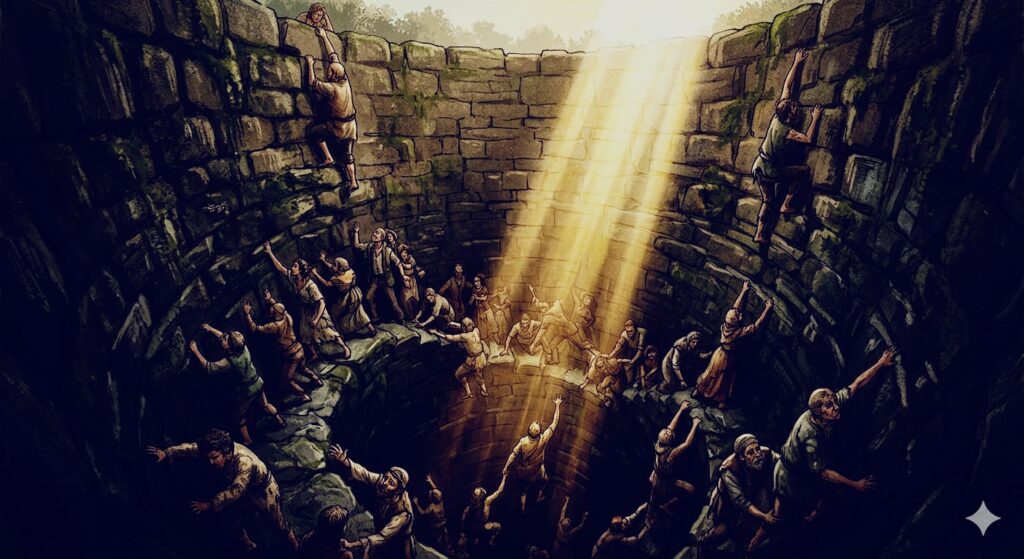
A farmer threw a dead pig into a dry well.
The smell spread. And within no time, seventy, eighty rats fell into that well. Easy food. They all feasted together. But when their stomachs were full and it was time to climb back out, that is when it hit them. They were trapped.
Days passed. The food ran out. Hunger changed everything.
The rats started eating each other.
A month later when the farmer came back, only one rat remained in that well. Eyes red, body torn, and whatever it once was, it was no longer that. The farmer pulled it out and released it into the field, but not out of mercy. Because that rat no longer ate grain. It had become a predator of its own kind.
I think about this story often, because I work in mental health, and most of the people who come to me carry pain that looks exactly like this well. Normal life on the outside. A war inside that never stops. This is not a coincidence. This is a deeply rooted psychological truth that most of us never stop to examine.
The People Who Come to Me
Some time ago, a man came to see me. Around forty years old. His voice carried exhaustion, and his eyes held that silence which sits beyond tears.
He said: “I am not tired of life. I am tired of the people closest to me.”
He told me his brother had taken his land. His mother looked the other way because she did not want to fight with her older son.
His wife was worn out, his children did not understand, and the neighbors watched the whole thing like it was entertainment.
He was completely alone, yet surrounded by people on all sides.
Then there was a young woman, twenty-five or twenty-six. She said: “I do not want to die. I just want everything to pause for a few days.
No one needing anything from me. No expectations.” When I asked more, it came out that her deepest pain was her own mother’s taunts, her husband’s indifference, and a close friend who had spread her most private secret across the entire neighborhood.
Both of them were like rats that had fallen into a well. The people they trusted pulled them in, and then those same people tore into them.
These are not unusual stories. When I sit and listen to the people who walk into my room, one thing is always the same. The pain did not come from enemies. It came from their own. And that pain cuts deeper because you never expect it from that direction.
This is the most important psychological truth of our society. And to understand it, we first need to look at what is actually happening around us.
And this psychological truth plays out in our homes and streets every single day.
Psychological Truth No. 1: When Fear Pushes Reason Aside
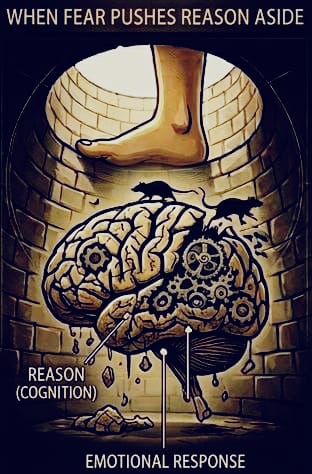
Here is what actually happens. The human brain cannot run two ways at once. Either it thinks, or it survives. When danger arrives, survival wins.
The rats in the well did not think. They only felt. Hunger. Fear. Survival. And in that single moment, they did what they never would have done otherwise.
Now look at Pakistani households. Inflation, unemployment, electricity bills, school fees, rent. All of it together creates a constant pressure. And when that pressure stretches from months into years, the mind stays on edge. It flinches at small things. It starts reading the people closest to it as threats.
I have seen fathers who love their children deeply but walk through the door and start a fight within minutes. Mothers who do not understand why they have become so irritable. The truth is they are not tired. They are scared. And a scared person looks for someone nearby and vulnerable to release on, because that feels safe.
This is why domestic arguments are rising, why anger on the streets has become ordinary, and why the flood of hostility on social media never seems to settle. People are angry, genuinely angry. But where that anger is actually going, nobody stops to ask.
This is the first psychological truth: a person living inside fear will always find an enemy, and almost always finds the wrong one. The person who understands this psychological truth can avoid a great many unnecessary battles.
Psychological Truth No. 2: Divide and Control
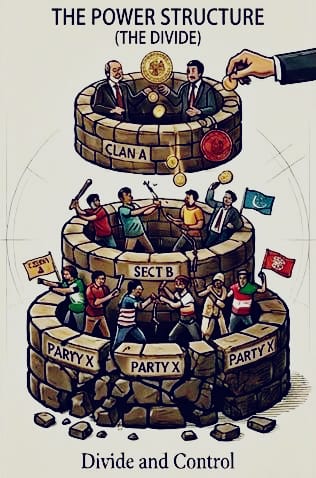
In the story, the farmer said nothing to the rats. No speech, no order. He threw a dead pig and walked away. The rats did the rest themselves.
Think about how clever that is.
The divisions along ethnic and regional lines in Pakistan today are not new. But they are being inflated more than ever before. Sectarian splits in the name of religion, hostility in the name of language, fractures running through families in the name of politics.
The problem is this. When a person attaches deeply to a group, that group’s enemies become their own enemies. Slowly, without them noticing. They cannot even tell when they handed their own mind over to someone else.
I have seen families where the father supports one political party and the son another, and years have passed without a real conversation between them. Both sitting in their own separate wells, each convinced the other is wrong.
The people at the top watch this and feel comfortable. They do not have to do anything. They just wait.
This is the second psychological truth: those with power only stay powerful as long as those below them stay tangled up with each other. This psychological truth is uncomfortable, but looking away from it changes nothing.
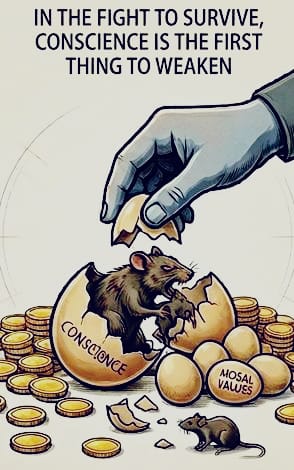
Psychological Truth No. 3: In the Fight to Survive, Conscience Is the First Thing to Weaken
The rats in the well were eating together at the start. They were not enemies. But when circumstances squeezed them, those same companions turned on each other.
People are not so different.
The only difference is that people have words to explain themselves to themselves. “Everyone does it.” “I had no other choice.” “This is just how the system works, what can I do alone.”
These are the sentences people use to quiet their conscience. And the painful part is that they work.
Today, dishonesty, deceit, and corruption are not hidden things. People know it is wrong and still do it, because the system has convinced them that honesty will not pay the bills.
In my work I have met people who say: “I know this is wrong, but if I do not do it, someone else will.” Every time I hear that sentence, something heavy settles in the room. Because that person is not lying. They are just speaking from inside a well where the way out is not visible.
When this thinking spreads, the whole environment shifts. And then the person who tries to stay honest gets treated as naive.
This is the third psychological truth: in survival mode, people do not lose their values all at once. They trade them away slowly, one justification at a time.
At the root of most of our social problems sits this one psychological truth.
Psychological Truth No. 4: When the Well Starts to Feel Like Home
The last rat pulled out of the well could not survive outside. It went into the field and instead of eating grain, it started hunting other rats. What the well had taught it had become its entire inner world.
An elderly man told me something I have not forgotten. He came to see me some time ago. Thirty years of conflict in his home, constant bitterness, a pattern of tearing each other down. When I asked if he had ever wanted to leave that behind, he paused and said: “Doctor sahib, this is life now. I cannot even remember any other kind.”
That sentence has stayed with me.
A child who grows up watching violence at home often comes to see violence as normal. A young person raised in a corrupt environment sees honesty as stupidity, not strength. This is not their failure. It is the effect of the well they were born into.
And the most painful part is that when the chance to get out comes, they freeze. Because the outside feels unfamiliar.
This is the fourth psychological truth: when a person stays in a painful place long enough, that place becomes their normal. And when something better appears, it feels threatening rather than welcoming.
Until we accept this psychological truth for what it is, climbing out of the well remains impossible.
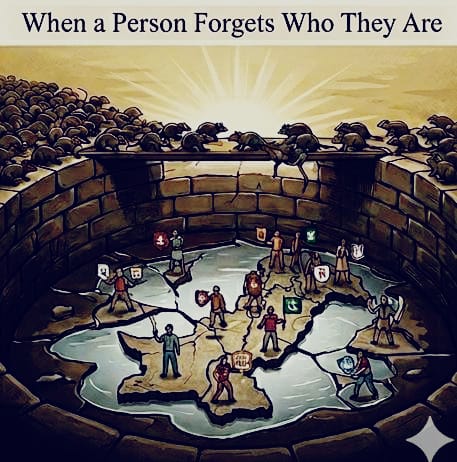
Psychological Truth No. 5: When a Person Forgets Who They Are
The last rat had lost its identity. It was no longer what it had once been.
The same happens to people. Just slowly enough that they do not notice.
Pakistan stands at this same point today. We are all Pakistani, everyone agrees on that. But what being Pakistani means is different for every group. For some it is religion, for some language, for some ethnicity, for some just a line drawn on a map. And every group is convinced the others have it wrong.
When a shared identity weakens, people take shelter in smaller ones. Clan, sect, party, region. These smaller identities give temporary comfort but pull attention further from the real question, which is: what do we all actually want?
I have seen young people whose eyes fill with something real when they talk about what Pakistan could be. But when you ask them simply, can you sit with someone different from you and actually listen, the room goes quiet.
Speaking in big terms is easy. Showing basic humanity to the person standing next to you is the hard part.
This is the fifth psychological truth: a people that forgets its shared identity does not fall apart all at once. It quietly chips itself down from the inside.
And perhaps this is the most painful psychological truth of all. That we already know. We just refuse to admit it.
The Way Out of the Well
So is there a way out?
There is. But it is not simple, and it does not come in a single sentence.
First, admit the well exists. Denial is comfortable. Saying “this does not apply to us” or “this is someone else’s problem” is easy. But nothing changes until you hold the mirror up.
Second, learn where your anger is actually going. The anger is real and it is justified. But it is landing on neighbors, relatives, people who speak a different language. The real question is who built this well. Who threw the pig in.
Third, move unity from a slogan into something actual. Unity does not mean everyone becoming the same. It means I sit with someone different from me, I listen, and I accept that their problem and my problem are not separate things.
And the last thing, which I have seen proven again and again in my work: the human mind can change. The people who come to me completely broken, they get back up. Slowly, with difficulty, but they do. As long as they believe getting up is possible.
So is there a way out? There is. And the first step begins with accepting this psychological truth, that the well was never locked from the outside.
Last Words
The farmer is still waiting to throw a new pig. He knows the hungry rats will come on their own.
But this time the question is: will we recognize that smell before we fall in?
The well is not broken from the outside. It breaks from within, when the people trapped inside decide they will stop tearing at each other and find a way out together.
The farmer is still waiting. And this psychological truth will not wait with you, either you see it today, or you fall in again tomorrow.
There is still time.
But time does not wait.